

Your Complete Guide to Choosing the Perfect Master’s Thesis Topic
Introduction
Selecting the right master’s thesis topic is one of the most critical decisions in your academic journey. A well-chosen topic can make your research process smooth, enjoyable, and valuable for your future career. A poorly chosen topic can lead to months of frustration, data collection nightmares, and academic struggles.
This comprehensive guide will walk you through a systematic, step-by-step approach to selecting your master’s thesis topic, ensuring you choose something that is:
- ✅ Research-worthy (has a genuine research gap)
- ✅ Data-accessible (you can actually complete it)
- ✅ Career-relevant (aligns with your professional goals)
- ✅ Academically sound (meets university requirements)
Let’s begin!
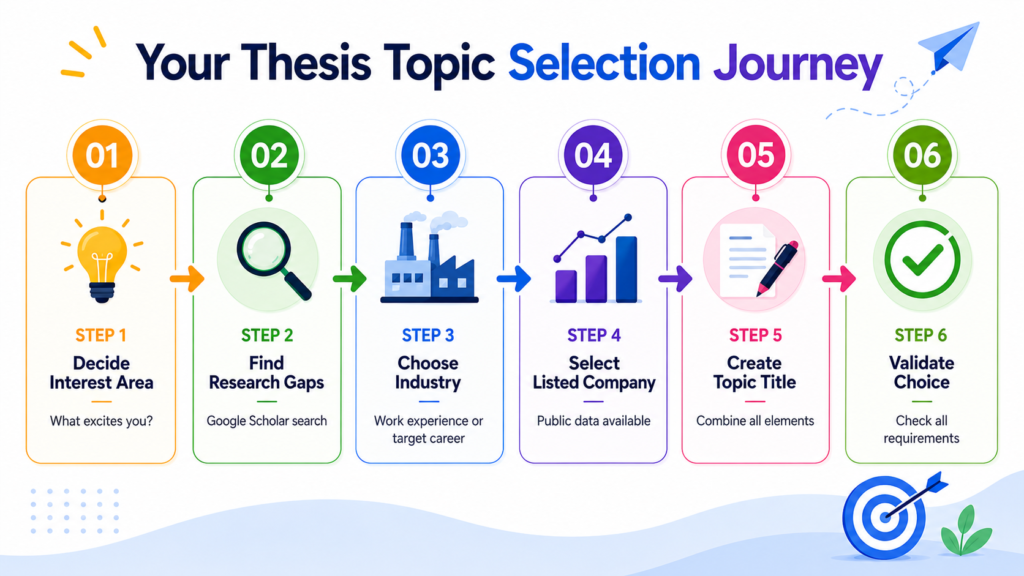
STEP 1: Decide Your Area of Interest
Why This Matters:
You’ll spend 6-12 months working on your thesis. If you’re not genuinely interested in the topic, you’ll struggle to stay motivated during literature reviews, data collection, and analysis.
How to Identify Your Interest Area:
Ask yourself these questions:
- Which subjects did I enjoy most during my coursework?
- Which topics do I naturally read about in my free time?
- What business problems fascinate me?
- What would I like to become an expert in?
Examples of Interest Areas (MBA/Business Management):
| Interest Area | Possible Topics |
|---|---|
| Marketing | Social media marketing, influencer marketing, brand loyalty, customer retention, digital advertising |
| Finance | Digital payments, financial inclusion, investment strategies, cryptocurrency adoption, fintech |
| Operations | Supply chain optimization, logistics efficiency, inventory management, quality control |
| Human Resources | Employee engagement, retention strategies, remote work management, mental health at work |
| Strategy | Business model innovation, competitive strategy, market entry strategies, digital transformation |
| Entrepreneurship | Startup funding, small business growth, e-commerce strategies, franchise models |
| Technology | AI in business, automation, digital platforms, e-commerce technology |
| Sustainability | Green business practices, ESG strategies, sustainable packaging, circular economy |
Action Step:
Write down 3-5 broad interest areas that genuinely excite you. For example:
- “I’m interested in how social media influences consumer behavior”
- “I want to understand digital payment adoption in emerging markets”
- “I’m curious about employee mental health in high-pressure industries”
STEP 2: Use Google Scholar to Find Research Gaps
Why This Matters:
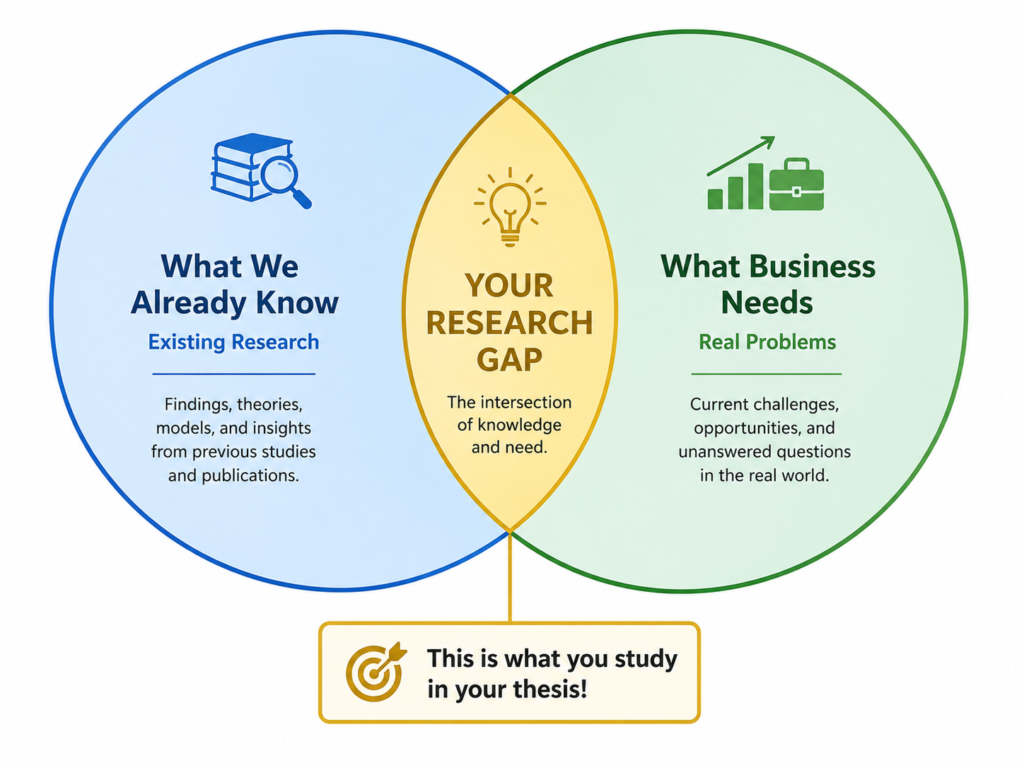
Your thesis must contribute something NEW to existing knowledge. This means identifying a research gap – something that hasn’t been studied enough or needs further investigation.
How to Search on Google Scholar:
Visit: scholar.google.com
Search Strategy:
- Start Broad:
- Search: “social media marketing consumer behavior”
- Search: “digital payment adoption India”
- Search: “employee mental health insurance industry”
- Look at Recent Papers (2020-2024):
- Click “Since 2020” filter
- This shows current research trends
- Read Abstracts and Conclusions:
- Don’t read entire papers yet
- Focus on “Future Research” or “Limitations” sections
- Authors often explicitly state research gaps!
- Look for Patterns:
- Multiple papers mention the same gap? → Good opportunity!
- No papers exist on specific angle? → Either great opportunity OR too niche
What Makes a Good Research Gap?
✅ Genuine Gap Examples:
- “Research shows loyalty programs exist, but doesn’t explain which features drive repeat purchases”
- “Studies discuss digital payments, but don’t compare what makes users trust one platform over another”
- “Papers identify employee stress, but lack frameworks for mental health support in specific industries”
❌ Fake Gaps (Avoid These):
- “No research exists on X” (usually false – search better!)
- “This company hasn’t been studied” (company isn’t the gap, the business problem is)
- “Indian context hasn’t been explored” (too vague)
Check Literature Availability:
You need minimum 30-50 sources for a master’s thesis!
Quick Test:
- Search your topic keywords on Google Scholar
- Count results from last 5 years
- Do at least 30-50 academic papers/books exist?
Example:
- Search: “customer loyalty retail India” → 15,000 results ✅ (Plenty available)
- Search: “blockchain in fertilizer distribution” → 50 results ⚠️ (May struggle to find 30 sources)
Action Step:
Spend 2-3 hours on Google Scholar:
- Search your interest areas
- Read 10-15 recent abstracts
- Note down 3-5 genuine research gaps
- Verify each gap has sufficient literature (30+ sources available)
STEP 3: Choose Your Industry or Field
Why This Matters:
Choosing an industry you’re familiar with (or want to enter) makes:
- Data collection easier
- Career networking opportunities
- Job applications stronger (thesis = portfolio piece)
Two Strategic Approaches:
Approach A: Leverage Your Work Experience
If you have 2+ years work experience:
Ask yourself:
- What industry do I currently work in?
- What business problems do I see daily?
- What could be improved in my company/industry?
Example:
- Work Experience: 3 years in banking operations
- Interest Area: Digital transformation
- Thesis Topic Direction: “Digital payment adoption and customer retention in Indian banking”
Benefits:
- ✅ You understand industry jargon
- ✅ You have professional network for surveys
- ✅ You can access insider insights
- ✅ Thesis helps current/future career
Approach B: Target Your Future Job Industry
If you’re a fresh graduate or career-switcher:
Ask yourself:
- Which industry do I want to work in after graduation?
- What skills do employers in that industry value?
- Which companies am I targeting for jobs?
Example:
- Target Industry: E-commerce/Retail
- Interest Area: Marketing
- Thesis Topic Direction: “Social media influencer marketing effectiveness in Indian fashion e-commerce”
Benefits:
- ✅ Thesis demonstrates industry knowledge to recruiters
- ✅ You can interview potential employers (networking!)
- ✅ You build expertise in target field
- ✅ Can reference thesis in job interviews
Popular Industries for MBA Thesis:
| Industry | Why Good Choice | Data Availability |
|---|---|---|
| Banking & Finance | High regulation = public data, growing digital transformation | ✅✅✅ Excellent |
| Retail & E-commerce | Consumer-facing = easy surveys, abundant research | ✅✅✅ Excellent |
| FMCG | Stable industry, large companies, public data | ✅✅✅ Excellent |
| Insurance | Post-COVID boom, digital transformation | ✅✅ Good |
| Technology/IT Services | Growing sector, innovation focus | ✅✅ Good |
| Automobiles | Established industry, EV transformation trending | ✅✅ Good |
| Hospitality & Tourism | Recovery post-pandemic, service focus | ✅✅ Good |
| Healthcare/Pharma | Always relevant, growing market | ✅ Moderate |
| Agriculture/Fertilizers | Important sector BUT limited academic research | ⚠️ Challenging |
| Heavy Manufacturing | B2B focused, harder surveys | ⚠️ Challenging |
Action Step:
Decide on one industry by answering:
- Do I have work experience here? OR
- Do I want to work here after graduation? OR
- Do I have genuine curiosity about this industry?
STEP 4: Select a Publicly Listed Company
Why This Matters:
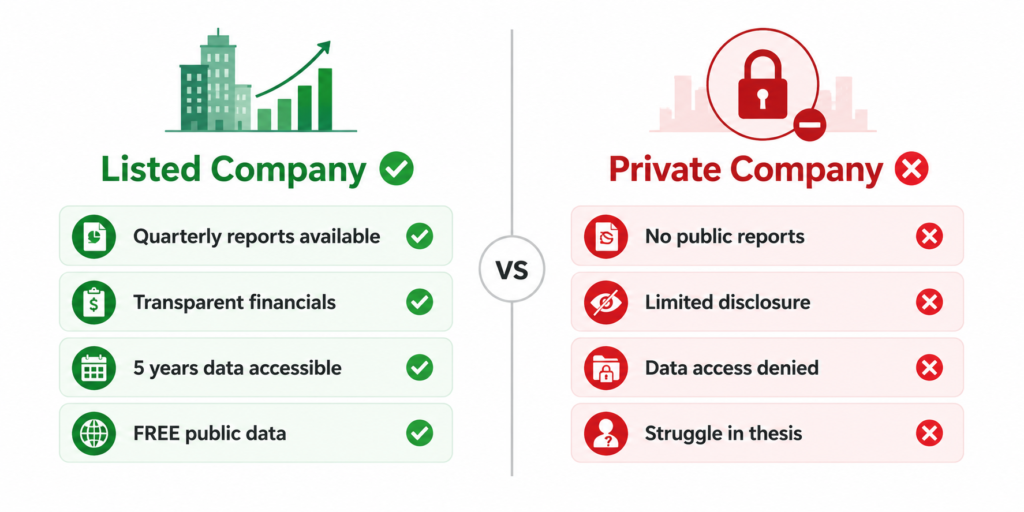
Publicly listed companies = FREE published data!
For master’s thesis, you need:
- 3-5 years financial data
- Operational metrics
- Industry benchmarks
- Company strategy information
Private companies don’t publish this data publicly.
What is a Listed Company?
Definition: A company whose shares trade on stock exchange (NSE/BSE in India, NYSE/NASDAQ in USA, LSE in UK, etc.)
Why Listed Companies Are Perfect for Thesis:
✅ Mandatory Disclosures:
- Quarterly financial reports
- Annual reports (100+ pages of data!)
- Investor presentations
- Management commentary
✅ Transparent Operations:
- Revenue breakdowns
- Cost structures
- Growth metrics
- Future strategies
✅ Industry Benchmarking:
- Compare with competitors
- Industry position clear
- Market share data
✅ Easy to Verify:
- All data is audited
- Regulatory oversight
- No access permission needed
How to Check if Company is Listed:
For Indian Companies:
- Visit: nseindia.com or bseindia.com
- Search company name
- If listed → You’ll see stock symbol (e.g., TCS = NSE: TCS)
For International Companies:
- Google: “[Company name] stock symbol”
- If listed → You’ll see ticker (e.g., Apple = NASDAQ: AAPL)
Examples of Good Listed Companies (India):
| Sector | Listed Companies | Stock Exchange |
|---|---|---|
| Retail | Trent (Zudio/Westside), DMart, Shoppers Stop | NSE/BSE |
| FMCG | Hindustan Unilever, Dabur, Marico, Godrej Consumer | NSE/BSE |
| Banking | HDFC Bank, ICICI Bank, IndusInd Bank, Axis Bank | NSE/BSE |
| Insurance | Star Health, ICICI Lombard, SBI Life | NSE/BSE |
| Automobiles | Tata Motors, Maruti Suzuki, Mahindra & Mahindra | NSE/BSE |
| IT Services | TCS, Infosys, Wipro, Tech Mahindra | NSE/BSE |
| E-commerce/Tech | Zomato, Nykaa, Policybazaar, Paytm | NSE/BSE |
| Electronics | Dixon Technologies, Amber Enterprises | NSE/BSE |
Examples of Companies to AVOID (Not Listed/Limited Data):
❌ Private Companies:
- BigBasket (owned by Tata Digital – not separately listed)
- Swiggy (private startup – no public financials)
- Lenskart (private – limited data)
- Byju’s (private – no financial transparency)
❌ Dying/Struggling Companies:
- Jet Airways (bankrupt)
- Future Retail (insolvency)
- Vodafone Idea (massive losses, may not survive)
How to Access Company Data:
Step 1: Find Annual Reports
- Google: “[Company name] annual report 2024”
- Visit company investor relations page
- Download last 3-5 years reports (usually PDF, 100-200 pages each)
Step 2: Check Quarterly Results
- Stock exchange websites publish quarterly updates
- Shows recent performance trends
Step 3: Industry Reports
- Google: “[Industry name] India report IBEF”
- IBEF (India Brand Equity Foundation) publishes free industry reports
- Industry associations also publish data
Action Step:
- List 5 companies in your chosen industry
- Check if they’re listed (NSE/BSE/NYSE)
- Download their latest annual report
- Verify you can find 3-5 years of data
- Choose ONE company for your thesis
STEP 5: Combine Everything into Your Final Topic
The Formula:
[Research Gap/Issue] + [Industry Context] + [at/in Company Name]
Examples:
Interest: Marketing
Industry: Consumer Electronics
Company: boAt (Imagine Marketing – Listed)
Research Gap: Influencer marketing ROI unclear
Final Topic: “Social media marketing and brand growth at boAt”
Interest: Finance
Industry: Banking
Company: IndusInd Bank (Listed)
Research Gap: Digital payment stickiness unknown
Final Topic: “Digital payment adoption and customer retention at IndusInd Bank”
Interest: HR/Psychology
Industry: Insurance
Company: ICICI Lombard (Listed)
Research Gap: Performance pressure vs mental health balance
Final Topic: “Employee mental health and HR support systems at ICICI Lombard”
Interest: Strategy
Industry: Retail
Company: Trent Limited (Listed)
Research Gap: What makes Zudio’s budget model successful
Final Topic: “Customer loyalty programs and repeat purchase behavior at Trent Limited”
Title Checklist:
Before finalizing, verify your title is:
- Concise (Under 15 words if possible)
- Specific (Mentions company name)
- Clear (Anyone can understand the topic)
- Research-focused (Not just “strategy to improve X”)
- Approved format (Check your university guidelines)
STEP 6: Validate Your Topic Choice
Before You Commit, Answer These Questions:
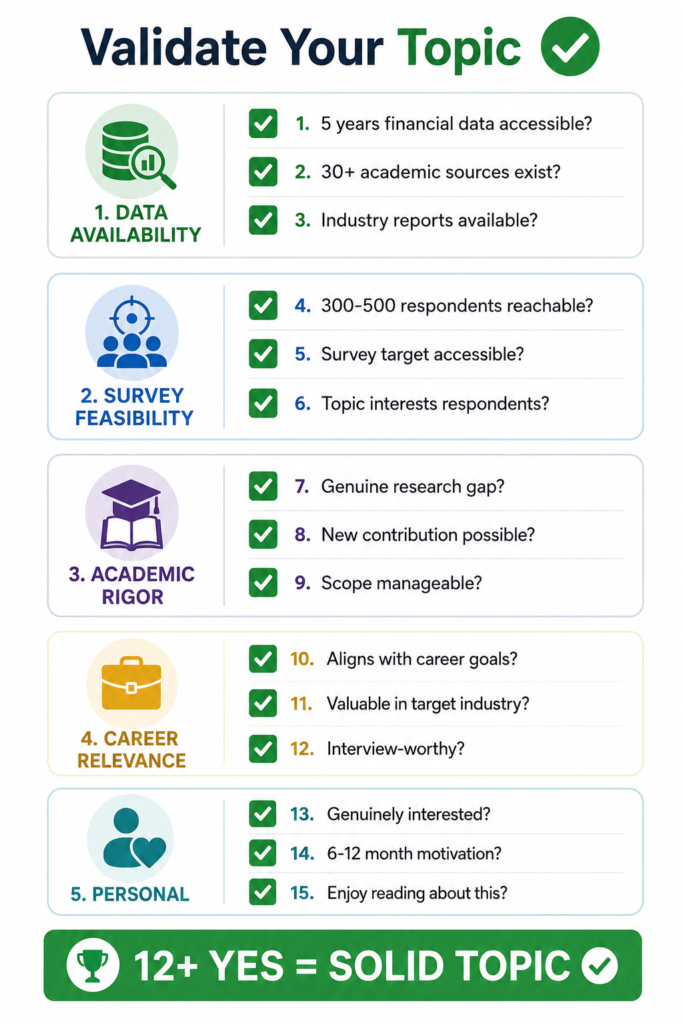
Data Availability:
- ✅ Can I access 5 years of company financial data?
- ✅ Can I find 30+ academic sources on this topic?
- ✅ Are industry reports available?
Survey Feasibility:
- ✅ Can I reach 300-500 survey respondents?
- ✅ Are they accessible (consumers, employees, professionals)?
- ✅ Will they respond (topic interests them)?
Academic Rigor:
- ✅ Does a genuine research gap exist?
- ✅ Can I contribute something new?
- ✅ Is the scope manageable (not too broad/narrow)?
Career Relevance:
- ✅ Does this topic align with my career goals?
- ✅ Can I discuss this confidently in job interviews?
- ✅ Will this expertise be valuable in my target industry?
Personal Interest:
- ✅ Am I genuinely curious about this?
- ✅ Can I stay motivated for 6-12 months?
- ✅ Do I enjoy reading about this topic?
If you answered YES to 12+ questions above → Your topic is SOLID! ✅
If you answered NO to 5+ questions → Reconsider and refine ⚠️
Common Mistakes to Avoid
❌ Mistake 1: Choosing Based on Company Fame Alone
Wrong: “I want to study Google because it’s cool”
Problem: Private data, access issues, too broad
Right: Choose based on research gap + data availability
❌ Mistake 2: Too Broad or Too Narrow
Too Broad: “Marketing strategies in Indian retail”
Too Narrow: “Instagram post engagement on Tuesdays for boAt”
Just Right: “Social media marketing and brand growth at boAt”
❌ Mistake 3: Ignoring Literature Availability
Problem: Choose exciting topic but only 10 papers exist
Solution: Always check Google Scholar BEFORE committing
❌ Mistake 4: Private Company Selection
Problem: Can’t get financial data, struggle in analysis chapter
Solution: ONLY choose publicly listed companies
❌ Mistake 5: Following Trends Blindly
Wrong: “Everyone’s doing AI, so I’ll do AI too”
Problem: May not match your interest/expertise
Right: Choose trending topics that GENUINELY interest you
Summary: Your 6-Step Action Plan
Week 1:
- ✅ Identify 3-5 interest areas
- ✅ Brainstorm potential topics
Week 2:
- ✅ Search Google Scholar for each topic
- ✅ Verify 30+ sources exist
- ✅ Identify genuine research gaps
Week 3:
- ✅ Decide on industry (current job OR target career)
- ✅ List 5 potential companies
- ✅ Check if they’re publicly listed
Week 4:
- ✅ Download annual reports
- ✅ Verify data availability (3-5 years)
- ✅ Combine into final topic title
Week 5:
- ✅ Validate with checklist
- ✅ Discuss with professors/mentors
- ✅ Get topic approved!
Need Help?
At EuroScholarly.com, we specialize in helping students:
- ✅ Select perfect thesis topics
- ✅ Conduct literature reviews
- ✅ Design research methodology
- ✅ Analyze data and write findings
- ✅ Meet university guidelines
Contact us for personalized thesis guidance!
Final Thoughts

Choosing your master’s thesis topic is not a decision to rush. Take your time, do your research, and select something that:
- You’re genuinely interested in
- Has sufficient academic literature
- Uses a publicly listed company with data access
- Aligns with your career goals
- Has a clear research gap
Remember: A well-chosen topic makes thesis writing enjoyable. A poorly chosen topic makes it torture.
Choose wisely. Research deeply. Succeed confidently.

Good luck with your master’s thesis journey!
Published by EuroScholarly.com – Your Partner in Academic Excellence